
You’ve seen the videos. Some guy in a backyard, katana gleaming in the afternoon sun, about to slice through a stack of water bottles, a car hood, maybe even a steel pipe. The camera zooms in. The sword comes down. And somehow, impossibly, the object splits in two like butter.
Cool? Absolutely. Real? Not even close.
Look, I get the appeal. Katanas have this legendary status that other swords just don’t have. There’s something about that curve, that razor edge, the whole samurai mystique—it makes you want to believe these things can cut through absolutely anything.
But here’s the truth: they can’t. And honestly? The real story is way more interesting than the fantasy.
I’ve been around katanas long enough to know what they can and can’t do. I’ve watched people ruin perfectly good blades trying to recreate viral video nonsense. I’ve also seen what happens when a skilled practitioner puts a quality sword through its paces on appropriate targets—and it’s genuinely impressive without any Hollywood magic.
So let’s cut through the BS (pun intended) and talk about what these swords actually are. We’ll cover the physics, the history, and why your favorite anime lied to you. Fair warning: some of your illusions are about to get shattered.
The katana showed up in feudal Japan around the 13th century, crafted by smiths who understood metal in ways that still impress modern metallurgists. These weren’t fantasy weapons—they were practical tools built to solve real problems. Understanding their limitations doesn’t ruin the magic. It just means you’re appreciating them for what they actually are instead of what movies told you they should be.
What Do People Even Mean by “Anything”?
When someone asks if a katana sword can cut through “anything,” they’re usually lumping together completely different materials without thinking about it. Let’s break this down:
Soft organic stuff like bamboo and tatami mats—basically tightly rolled straw. This is what swordsmen have been testing with for centuries.
Human targets. Yeah, we’re going there. Because historically, that’s what these swords were built for. Flesh, bone, and whatever armor people were wearing at the time.
Hard brittle materials—bricks, ceramics, concrete. These might shatter under the right conditions, but they’re terrible for the blade.
Modern industrial materials. Steel beams, car parts, industrial cables. This is where viral videos live, and it’s complete fantasy land compared to what a feudal warrior dealt with.
Here’s what nobody tells you: a blade optimized for cutting one type of material will absolutely suck at cutting another. That’s not a bug—that’s just how physics works. You can’t build a universal cutting machine in sword form. Anyone who claims otherwise is selling you something.
Why Physics Says “Nope”
Cutting isn’t magic. It’s geometry, force, and material properties. Let’s break it down without getting too nerdy.
Edge geometry matters.
A katana’s edge is ground to about 15-30 degrees depending on what it’s meant for—slightly more acute than European swords, which typically sit at 20-25 degrees. Sharper angles cut soft stuff beautifully but chip like crazy on hard surfaces. Thicker angles last longer but won’t slice cleanly. You’re always trading one for the other. Research published in The Pattern-Welded Blade confirms that acute angles under 20 degrees increase sharpness but reduce durability exponentially.
Speed helps, but it’s not everything.
Yeah, momentum matters. The katana’s curve actually helps with draw-cuts where you pull the blade through as you swing. In fact, according to research published in the Journal of Materials Science, curved blades require 30-40% less force than straight blades for equivalent cuts. But even with that mechanical advantage, perfect technique can’t overcome basic material science.
Hardness is king.
This is the big one. If your target is harder than your blade’s edge, your blade loses. Period.
Katana edges typically clock in around 60-62 on the Rockwell hardness scale (HRC), with the spine measuring softer at 40-45 HRC due to differential hardening, according to Leon Kapp’s definitive work The Craft of the Japanese Sword. Modern tool steel, tungsten, hardened ceramics—these materials can exceed 70 HRC and laugh at that number. Try to cut them, and you’re just destroying your sword.
Think of it like this: you can’t cut a diamond with a kitchen knife no matter how hard you swing. Same principle applies here. The internet wants you to believe that technique or “sharpness” can overcome material properties, but that’s just not how the universe works.
Hollywood Ruins Everything
We need to talk about the elephant in the room: every katana video you’ve ever seen is lying to you.
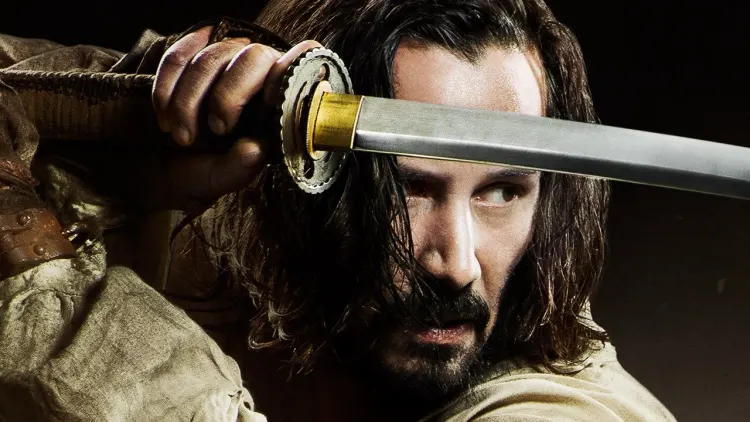
Not all of them are outright fakes, but they’re all misleading in some way. Here’s how:
The targets are rigged.
That concrete block? Probably aerated concrete, which is way softer than structural concrete. That “steel plate”? Could be aluminum, could be mild steel (which measures around 120-150 on the Brinell hardness scale, roughly 65-70 HRC equivalent according to the ASM Handbook on Mechanical Testing) positioned at the perfect angle, could be pre-scored. Those water bottles? Come on.
Editing does heavy lifting.
What looks like one clean cut might be three takes stitched together. Or they’re showing you the one success after fifteen failures. You never see the footage of the blade getting trashed.
Those aren’t even real katanas.
Some of these tests use industrial cutting tools shaped like katanas, or modern super-steel that would make a traditional swordsmith weep. Calling it a “katana” makes for better clicks.
I’ve watched enough of these videos to spot the tells. The camera cuts away just before impact. The “after” shot doesn’t show the blade close-up. The guy doing the cutting immediately walks away without examining the edge. These are red flags.
A real katana, made the traditional way, used against genuinely hard materials? It’ll either bounce off or get wrecked. And that’s fine! It’s not supposed to cut through car doors.
What These Swords Were Actually Built For
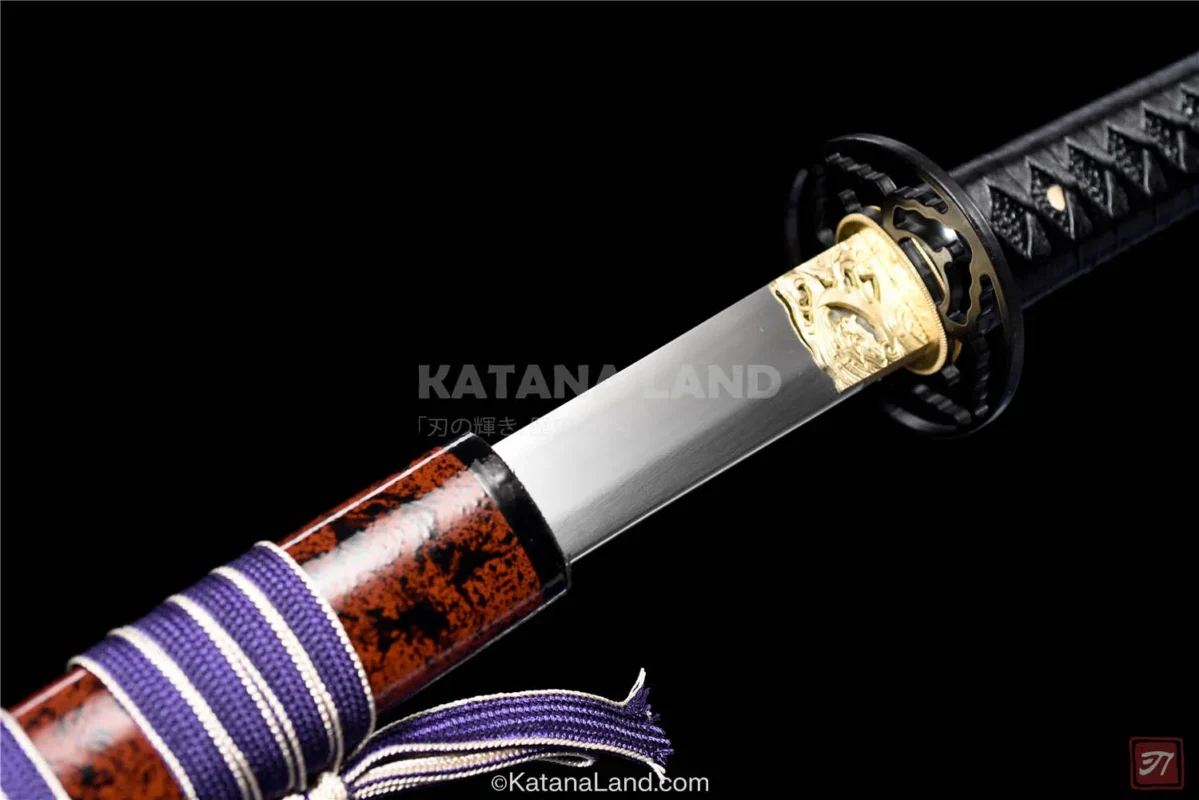
Let’s rewind to medieval Japan and talk about what katanas were actually designed to do, because that’s where things get interesting.
Samurai needed a weapon that could:
- Slice through the cloth, leather, and lacquered armor that was common in Japanese warfare
- Deliver devastating cuts to anyone who wasn’t heavily armored
- Be drawn and used fast in close quarters
- Pull double duty as both a battlefield weapon and a dueling tool
And you know what? Katanas were phenomenal at all of this.
Dr. Karl Friday’s extensive research on medieval Japanese warfare, documented in Samurai, Warfare and the State in Early Medieval Japan, shows that well-made katanas in skilled hands could sever limbs, penetrate typical Japanese armor, and end a fight with a single stroke. That’s not movie magic—that’s documented reality.
But here’s the context that gets left out: Japanese armor wasn’t the full plate steel you see on European knights. Battlefields weren’t full of steel beams and industrial equipment. The katana was a brilliant solution to actual problems that Japanese warriors faced, not some kind of universal super-weapon.
There’s even a great historical example of the katana’s limits: during the Mongol invasions of 1274 and 1281, Japanese swordsmen found their blades were chipping against the Mongols’ hardened leather and metal armor. The Mōko Shūrai Ekotoba, a 13th-century illustrated scroll documenting these battles, actually depicts Japanese swords being damaged in combat. As Thomas Conlan notes in In Little Need of Divine Intervention, this forced real changes in Japanese sword design and tactics—blades became thicker and more durable. Even in its own time period, the katana had limitations—it was just exceptionally good at what it needed to be good at.
The Damage Nobody Shows You
Here’s my favorite part of viral cutting videos: they almost never show you what the blade looks like afterward.
Want to know why? Because forcing a katana to cut materials it wasn’t designed for absolutely destroys it:
Chips and cracks appear along the edge. Even small ones compromise the entire cutting ability. The edge is only as good as its weakest point.
Edge roll happens when the edge folds over instead of cutting through. According to J.D. Verhoeven’s Metallurgy of Steel for Bladesmiths, this occurs when yield strength is exceeded without fracture. Fixing this requires serious work—you’re basically re-grinding the edge.
Complete failure. I’ve seen blades crack. I’ve seen them shatter. Especially cheaper ones or anything with brittle steel. Verhoeven’s research shows that chipping occurs when impact stress exceeds 200,000 psi locally. Once a blade cracks, it’s done. You don’t fix that.
Those viral videos conveniently cut away before showing the blade’s condition. That “amazing cut through a car hood”? Probably left the sword looking like it got chewed up by a garbage disposal.
This is where quality matters. A well-made katana from good steel, properly maintained, will last generations—if you use it as intended. Try to turn it into a crowbar or industrial cutter, and you’ve got an expensive piece of scrap metal.
I can’t tell you how many times I’ve seen someone bring me a katana they ruined trying to recreate some YouTube stunt. It’s like taking a Ferrari off-roading and being surprised when the suspension breaks.
The Sharp vs. Tough Problem
There’s a fundamental rule in blade-making that explains everything: you can make a blade sharp, or you can make it tough. You can’t maximize both.
Go for sharpness? You get a razor-thin edge that’ll slice soft materials like a dream. But that same edge chips easily, dulls fast on anything remotely hard, and needs constant maintenance.
Go for toughness? You get a thicker edge that can handle harder materials without breaking, but it won’t cut cleanly. You’re basically chopping instead of slicing.
Traditional katanas split the difference. They’re optimized for cutting soft targets—read: people—while staying durable enough for actual combat use. The traditional steel, tamahagane, contains 0.5-1.5% carbon content according to research by Rostoker and Bronson in Pre-Industrial Iron: Its Technology and Ethnology, while modern tool steels range from 0.7-2.1% carbon with various alloys that dramatically change their properties.
Here’s how different types stack up:
Decorative katanas have thin or unsharpened edges. They’re for looking at, not using. Try to cut anything and you’ll hurt yourself.
Functional katanas (traditional style) have medium-thickness, hand-forged edges. These are for tameshigiri—actual cutting practice. Use them right, they’re amazing. Use them on steel pipes, they’re toast.
Practice blades (iaito) are thick or completely unsharpened. They’re for learning forms and movements safely. Not for cutting, period.
Modern “tactical” blades have thick, machine-ground edges built for durability. They can handle abuse, but they cut like garbage compared to a traditional katana on appropriate targets.
The best katana depends entirely on what you’re doing with it. Want to practice traditional cutting? You need a properly balanced, sharp functional blade. Just want something beautiful on your wall? Get a gorgeous display piece. Learning the basics? Start with an iaito and don’t risk hurting yourself.
Tests That Actually Mean Something
If viral videos show us what katanas can’t do, what can they do? And how do serious practitioners actually test their blades?
Traditional Japanese swordsmanship has specific targets that reveal whether both the blade and the swordsman are any good:
Tatami omote—rolled straw mats soaked in water. This is the gold standard. According to the All Japan Swordsmithing Association testing protocols, cutting through 3 rolled tatami mats is the standard test for blade quality. When properly soaked, tatami density sits at approximately 0.98-1.02 g/cm³—remarkably similar to human soft tissue. A clean cut through multiple mats requires everything to be right: blade alignment, cutting angle, edge geometry, and technique. Screw up anywhere, and the mat won’t separate cleanly. It’s immediately obvious.
Bamboo. Green bamboo is nasty to cut. The fibrous structure means you can’t just muscle through it—your technique has to be solid or you’ll bounce right off. As documented in Donn Draeger’s Classical Bujutsu, bamboo has been a standard test material for centuries.
Ballistic gel. Some historical researchers use this to understand wound patterns and how katanas would’ve performed in actual combat. John Currey’s biomechanics research in Bones: Structure and Mechanics provides insight into material fracture and penetration mechanics. It’s less common in traditional practice, but useful for academic purposes.
Notice what all these have in common? They relate to what the katana was actually designed for. Cutting tatami mats cleanly tells you something meaningful about the blade and the person swinging it. Cutting through a car hood tells you… that you wasted a sword for internet points.
Why This Myth Won’t Die
If the physics and history are this clear-cut, why do people keep believing katanas can slice through anything?
Anime ruined everything. Shows like Demon Slayer and Bleach feature swords that do impossible things. Which is fine—they’re fantasy stories. The problem is people forget where the line between fiction and reality sits.
Social media rewards lies. A video titled “I cleanly cut some bamboo mats” gets a few thousand views. A video titled “KATANA DESTROYS STEEL BEAM!!!” gets millions. Truth doesn’t pay the bills. Spectacle does.
We want to believe. Let’s be real—the idea of a perfect weapon that can overcome any obstacle is appealing. It’s the same reason we love superhero movies and fantasy novels. There’s something romantic about it.
But here’s the thing: you don’t need myths to appreciate katanas. The truth is genuinely fascinating. These swords represent centuries of metallurgical knowledge, insane craftsmanship, and martial tradition. That’s impressive without any exaggeration needed.
By being honest about what katanas can and can’t do, you actually build more credibility. People who want real information will remember you told them the truth while everyone else was selling fantasies.
Better Questions to Ask
Instead of “Can a katana cut through anything?” let’s ask questions that actually matter:
What makes a katana exceptional at its intended purpose?
The precision is unreal. When you watch someone who knows what they’re doing make a cut with a katana, it’s almost surgical. The geometry, balance, and curve work together to allow incredibly controlled movements. But the margin for error is tiny, which is why mastering these swords takes years.
The balance feels impossible until you hold a good one. A well-made katana feels lighter than it should. The balance point sits in exactly the right spot, making it quick and responsive without being exhausting to use. Cheap knockoffs feel wrong in your hand immediately—the difference is night and day.
The craftsmanship is where things get really interesting. Traditional sword-making involves dozens of steps over months. The blade is folded 10-16 times creating over 32,000 layers, which removes impurities and homogenizes carbon distribution—though as B.W. Robinson notes in The Arts of the Japanese Sword, there are diminishing returns beyond 15 folds. Then comes the differential hardening process (yakiire), where clay application creates that hardness differential of 15-20 points HRC between edge and spine according to Leon and Hiroko Kapp’s research in Modern Japanese Swords and Swordsmiths. Finally, polishing reveals the steel’s patterns. Each sword is unique, a collaboration between swordsmith, polisher, and fittings-maker. That’s art.
The history connects you to something bigger. Traditional Japanese sword-making has been designated as an Important Intangible Cultural Property by UNESCO. There are approximately 300 licensed swordsmiths in Japan today, limited by law to producing just 24 blades per year. Waiting lists for master smiths range from 3-10+ years. Owning a katana links you to centuries of martial tradition and Japanese culture. No viral video can replicate that.
And yeah, they’re gorgeous. Even if you never cut anything with one, just looking at a well-made katana is an experience. The curve, the steel patterns, the artistry in the fittings—these are functional sculptures.
When you look at katanas this way, the conversation shifts from “what can it destroy?” to “what does it represent?” And that’s infinitely more rewarding.
The Truth Wins
Let’s wrap this up:
Katanas can’t cut through anything. Physics and material science impose real limits that no amount of sharpness or technique can overcome.
Hollywood and the internet use tricks, camera angles, and rigged tests to create impossible-looking cuts. It’s entertainment, not education.
Katanas were designed for specific historical purposes: cutting through flesh, bone, and the armor of feudal Japan. They’re brilliant at that. Everything else is fantasy.
Trying “impossible” cuts destroys blades, often permanently. Those viral videos conveniently hide the damage.
The real appeal of katanas is in their precision, balance, craftsmanship, and cultural weight—not in fantasy feats they were never meant to perform.
Does knowing all this make katanas less cool? Hell no. If anything, understanding what these swords actually are makes them more impressive. They’re masterfully crafted tools optimized for specific purposes, not magical props from an anime.
Next time you see a video claiming a katana cut through something impossible, you’ll know better. And if you ever hold a quality katana yourself, you’ll appreciate it for what it truly is: functional art representing centuries of tradition and knowledge.
Want the real thing?
If you’re thinking about getting a katana—for practice, display, or collecting—focus on quality. Look for reputable makers, proper materials, and honest craftsmanship. Need a functional blade for tameshigiri? Get one built for cutting. Want a display piece? Find something beautiful that speaks to you. And grab maintenance supplies—a well-cared-for katana outlives you.
The myths are fun. But reality is better.
Quick fact: That distinctive katana curve isn’t decorative—it’s created during differential hardening, where the edge and spine cool at different rates, causing the blade to naturally curve. Form follows function.
Did you know? Traditional Japanese swordsmiths still make katanas using techniques that haven’t changed in centuries. Licensed smiths are limited to 24 blades per year by Japanese law, and some have waiting lists measured in years.
Myth busted: “Katanas can cut through gun barrels.” Nope. Gun barrels are hardened steel significantly harder than a katana’s edge (often exceeding 70 HRC compared to the katana’s 60-62 HRC). You’d just wreck the sword.